●/bibliography
Austin, J.L.
1962
How to Do Things with Words
Clarendon Press, Oxford
performative utterance
In the 1960s, at the same time when performance art stepped out of the conformist traditional art world, John L. Austin pragmatically rethought the nature of words. To understand his core idea of the performative utterance, one has to accept, that saying something is also doing something. Austin claimed the performative speech act could not be reduced only to constative utterances that provide us with a description of the world such as the statement: “It’s a sunny day”. In contrast, a performative act forces its limits by projecting an intention - a task. Therefore, it can be extended as a mode of action. Let’s take, for example, Austin’s famous marriage act phrase “I do”, which goes beyond reporting because it contains acting. The marriage as procedure - a ritual - makes this statement valid. Thus, performative utterances don’t only describe or report but also contain the potential to create.
Badiou, Alain
2017
‘A Theatre of Operations’
in Bridget Crone (ed.), The Sensible Stage: Staging and the Moving Image, Intellect, Bristol
"Theatre is an art and art will always be a site divided between subversion and institution, contemplative passivity and active rupture, the State and the crowd, creation and the market." – Alain Badiou, The Sensible Stage (p. 20) “If we define ‘theatre without theatre’ as a form of pure theatricality, a modality of the presence of bodies freed from representation, performance comes down to the organization, according to an intention to create art, of an immediate experience of being-together." – Elie During, The Sensible Stage (p. 20) "A crucial question has emerged here. Whatever its site, closed or open, scenic or nomadic, close to or distant from itself, theatre is always a public meditation on the relation or non-relation between artifice and life." – Alain Badiou, The Sensible Stage (p. 25)
Barad, Karen
2003
‘Posthumanist Performativity: Toward an Understanding of How Matter Comes to Matter’
Signs: Journal of Women in Culture and Society 28, no. 3, pp. 801–831
Agency, Diffraction, Embodiment, Entanglement, New Materialism, Non-human, Non-Human Agency, Poncho, Posthumanism, Posthumanist Performativity
Drawing on quantum physics, feminist theory, science and technology studies, and poststructuralism, Barad argues that matter is not passive or simply given to us. Matter and meaning emerge together through material-discursive practices. Her approach, which she calls agential realism, rejects a strict separation between subjects and objects, humans and nonhumans, and discourse and materiality. Instead, entities and their boundaries are produced through specific interactions or “intra-actions.” Barad therefore asks us to reconsider how phenomena come into existence and how our practices participate in producing the realities we study. Barad argues that reality is not made up of pre-existing, independent subjects and objects; instead, subjects, objects, meanings, and material boundaries emerge together through material-discursive “intra-actions.” What we can learn from the text is that knowledge and reality-making are material practices with ethical and political consequences.
Baumann, D., M. Jäggi and M. Mueller
2015
Benjamin, Walter
1968
‘The Task of the Translator’
in Illuminations, ed. Hannah Arendt, trans. Harry Zohn, Harcourt Brace Jovanovich, New York
Benjamin argues that translation should not simply reproduce the meaning of an original text for another audience; instead, it should reveal the deeper relationship between different languages, each of which expresses only part of a larger language. What we can learn from the text is that translation is not a secondary act of copying but a creative transformation through which both the original work and the possibilities of language can continue to “live” in new linguistic and historical contexts.
Bennett, Jane
2010
Vibrant Matter: A Political Ecology of Things
Duke University Press, Durham
Agency, Book as Mud, More-Than-Human, New Materialism, Non-human, Non-Human Agency, Posthumanism, Vibrant Matter
In Vibrant Matter the political theorist Jane Bennett, renowned for her work on nature, ethics, and affect, shifts her focus from the human experience of things to things themselves. Bennett argues that political theory needs to do a better job of recognizing the active participation of nonhuman forces in events. Toward that end, she theorizes a "vital materiality" that runs through and across bodies, both human and nonhuman. Bennett explores how political analyses of public events might change were we to acknowledge that agency always emerges as the effect of ad hoc configurations of human and nonhuman forces. She suggests that recognizing that agency is distributed this way, and is not solely the province of humans, might spur the cultivation of a more responsible, ecologically sound politics: a politics less devoted to blaming and condemning individuals than to discerning the web of forces affecting situations and events. Bennett examines the political and theoretical implications of vital materialism through extended discussions of commonplace things and physical phenomena including stem cells, fish oils, electricity, metal, and trash. She reflects on the vital power of material formations such as landfills, which generate lively streams of chemicals, and omega-3 fatty acids, which can transform brain chemistry and mood. Along the way, she engages with the concepts and claims of Spinoza, Nietzsche, Thoreau, Darwin, Adorno, and Deleuze, disclosing a long history of thinking about vibrant matter in Western philosophy, including attempts by Kant, Bergson, and the embryologist Hans Driesch to name the "vital force" inherent in material forms. Bennett concludes by sketching the contours of a "green materialist" ecophilosophy
Bishop, Claire
2012
Artificial Hells: Participatory Art and the Politics of Spectatorship
Verso, London
Inclusivity, Institutional Critique, Instrumentalization, Invitation, Participation, Political art, Relational Aesthetics, Spectatorship
Since the 1990s, critics and curators have broadly accepted the notion that participatory art is the ultimate political art: that by encouraging an audience to take part an artist can promote new emancipatory social relations. Around the world, the champions of this form of expression are numerous, ranging from art historians such as Grant Kester, curators such as Nicolas Bourriaud and Nato Thompson, to performance theorists such as Shannon Jackson. Artificial Hells is the first historical and theoretical overview of socially engaged participatory art, known in the US as 'social practice.' Claire Bishop follows the trajectory of twentieth-century art and examines key moments in the development of a participatory aesthetic. This itinerary takes in Futurism and Dada; the Situationist International; Happenings in Eastern Europe, Argentina and Paris; the 1970s Community Arts Movement; and the Artists Placement Group. It concludes with a discussion of long-term educational projects by contemporary artists such as Thomas Hirschhorn, Tania Bruguera, Pawel Althamer and Paul Chan. Since her controversial essay in Artforum in 2006, Claire Bishop has been one of the few to challenge the political and aesthetic ambitions of participatory art. In Artificial Hells, she not only scrutinizes the emancipatory claims made for these projects, but also provides an alternative to the ethical (rather than artistic) criteria invited by such artworks. Artificial Hells calls for a less prescriptive approach to art and politics, and for more compelling, troubling and bolder forms of participatory art and criticism.
Boal, Augusto
1979
Theatre of the Oppressed
trans. Charles A. and Maria-Odilia Leal McBride, Pluto Press, London (first published 1974)
Boal argues that traditional theatre often places audiences in a passive position: spectators watch actors perform a story but remain separated from the action. Drawing on Paulo Freire’s ideas about oppression and critical pedagogy, Boal proposes a form of theatre in which spectators become active participants—or “spect-actors”—who can intervene in the performance and experiment with different ways of responding to situations of oppression. Theatre therefore becomes not only a form of artistic expression but also a space for political education, reflection, and collective action. Through techniques such as Forum Theatre, Image Theatre, and the Theatre of the Oppressed more broadly, participants can identify oppressive structures, rehearse possible responses, and explore how social relationships might be transformed. Boal sees theatre as a kind of rehearsal space where people can experiment with actions before confronting similar situations outside the theatre. What we can learn from the text is that theatre can function as a rehearsal for social and political life, allowing people to move from simply recognizing oppression toward collectively imagining and practicing possible forms of resistance and change.
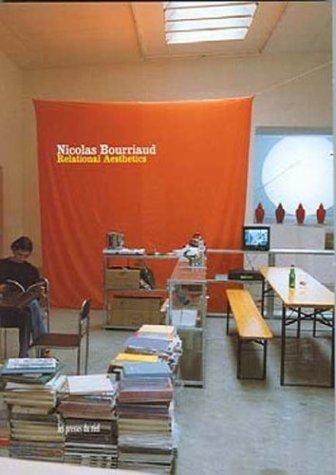
Bourriaud, Nicolas
2002
Relational Aesthetics
trans. Simon Pleasance and Fronza Woods, Les Presses du Réel, Dijon
Engagement, Passive, Relation, Relational Aesthetics, Relational Art, Representation, Situation
Where does our current obsession for interactivity stem from? After the consumer society and the communication era, does art still contribute to the emergence of a rational society? Bourriaud attempts to renew our approach toward contemporary art by getting as close as possible to the artists works, and by revealing the principles that structure their thoughts: an aesthetic of the inter-human, of the encounter; of proximity, of resisting social formatting.
Braidotti, Rosi
2013
The Posthuman
Polity Press, Cambridge
Feminist Methodologies, New Materialism, Posthumanism, Situated Knowledge
Braidotti argues that the posthuman helps us make sense of our flexible and multiple identities. She then analyzes the escalating effects of post-anthropocentric thought, which encompass not only other species, but also the sustainability of our planet as a whole. Because contemporary market economies profit from the control and commodification of all that lives, they result in erasing categorical distinctions between the human and other species, seeds, plants, animals and bacteria. Braidotti outlines new forms of cosmopolitan neo-humanism that emerge from the spectrum of post-colonial and race studies, as well as gender analysis and environmentalism. The challenge of the posthuman condition consists in seizing the opportunities for new social bonding and community building, while pursuing sustainability and empowerment.
Butler, Judith
2015
Notes Toward a Performative Theory of Assembly
Harvard University Press, Cambridge, MA; includes ‘“We, the People”: Thoughts on Freedom of Assembly’
Assembly, Democracy, Performativity, Political art, Polyvocal , Together, Togetherness, Voice
When people assemble, occupy streets or squares, demonstrate, strike, or gather in protest, their collective bodily presence can challenge who is allowed to appear in public, who is considered visible or legitimate, and whose lives are recognized as valuable. Butler examines how people’s bodies come together in public spaces to make political claims. She argues that political action does not happen only through speech, slogans, or explicit demands; the physical presence of bodies themselves can be a form of political expression. Butler connects performativity to collective assembly, arguing that political subjects are produced through their relationships with others and through the material conditions that make assembly possible. The book therefore explores how bodies depend on one another and on social infrastructures while simultaneously using public space to demand rights, recognition, equality, and livable conditions. When bodies assemble in public, their collective presence itself becomes a political and performative act: people demonstrate not only through what they say but through the fact that they appear together and claim space. What we can learn from the text is that political agency is collective and embodied, and that struggles over visibility, public space, recognition, and livable conditions are also struggles over whose lives are allowed to matter.
Carrión, Ulises
1975
The New Art of Making Books
Artpool, Budapest (first published in Kontexts, no. 6–7)
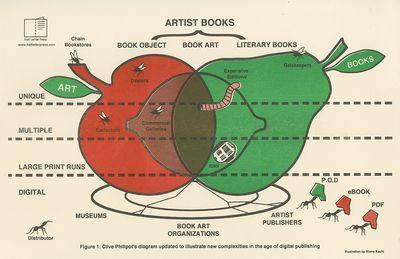
Chappell, Duncan
2003
‘Typologising the Artist’s Book’
Art Libraries Journal 28, no. 4, pp. 12–20
Clough, Patricia Ticineto (ed.)
2007
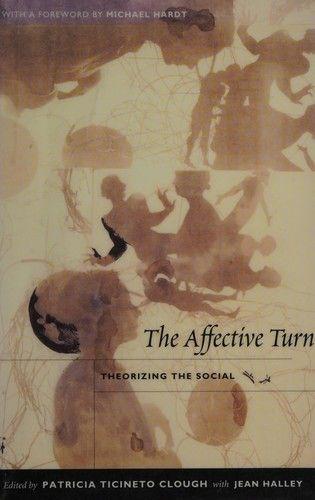
In the mid-1990s, scholars turned their attention toward the ways that ongoing political, economic, and cultural transformations were changing the realm of the social, specifically that aspect of it described by the notion of affect: pre-individual bodily forces, linked to autonomic responses, which augment or diminish a body's capacity to act or engage with others. This 'affective turn' and the new configurations of bodies, technology, and matter that it reveals, is the subject of this collection of essays. Scholars based in sociology, cultural studies, science studies, and women's studies illuminate the movement in thought from a psychoanalytically informed criticism of subject identity, representation, and trauma to an engagement with information and affect; from a privileging of the organic body to an exploration of nonorganic life; and from the presumption of equilibrium-seeking closed systems to an engagement with the complexity of open systems under far-from-equilibrium conditions. Taken together, these essays suggest that attending to the affective turn is necessary to theorizing the social.
Costanza-Chock, Sasha
2020
Design Justice: Community-Led Practices to Build the Worlds We Need
MIT Press, Cambridge, MA
Collectivity, Decolonial Design, Design Justice, Inclusivity, Others, Polyvocal
Costanza-Chock argues that conventional design practices often reproduce existing systems of power, inequality, and exclusion, even when designers intend to create helpful or innovative solutions. Design justice therefore asks us to shift attention from designing for communities to designing with and by communities, especially those most affected by the systems being designed. The book emphasizes that communities should have meaningful control over the design processes that shape their lives, rather than simply being treated as users, research subjects, or consumers. Costanza-Chock combines design theory with examples from technology, activism, disability justice, and community organizing to propose design as a practice of collective empowerment and social transformation. Important concept is "Design with / by rather than for" which explains that communities should not simply be recipients of solutions created by designers. They should be active participants and decision-makers in the design process.

Cotter, Lucy (ed.)
2019
Reclaiming Artistic Research
Hatje Cantz, Berlin
Artistic Research, Design epistemology, Design skills, Undisciplined
The book embraces contemporary art’s multisensory modes of witnessing and highlights how artists’ gathering and creation of material, textual, and embodied sources of knowledge can support the decolonization of knowledge, the centering of Indigenous ways of knowing, and the creation of greater accessibility to knowledge. Through radical archival interventions and oral-material creations, many featured artists find ways to manifest and engage with the fragmentation and dispersal of human histories in ways that the discipline of history struggles (and often fails) to do. This matters in a world in which marginalized peoples, enslaved and disappeared peoples, and those who have faced forced migrations, genocide, and extinction seek to claim their own histories and trajectories.
Crone, Bridget (ed.)
2017
The essays in this volume re-invigorate notions of ‘staging’ and theatricality through consideration of contemporary art practices that work across moving image and live performance. Here these terms pertain not to a stylistic tendency but rather to the creation of a space in which the relationship between the immediacy of performance and the reproducibility of the image is re-addressed and indeed, re-combined so that new combinations and inter-relationships emerge. "A crucial question has emerged here. Whatever its site, closed or open, scenic or nomadic, close to or distant from itself, theatre is always a public meditation on the relation or non-relation between artifice and life." – Bridget Crone, The Sensible Stage, (p.25).
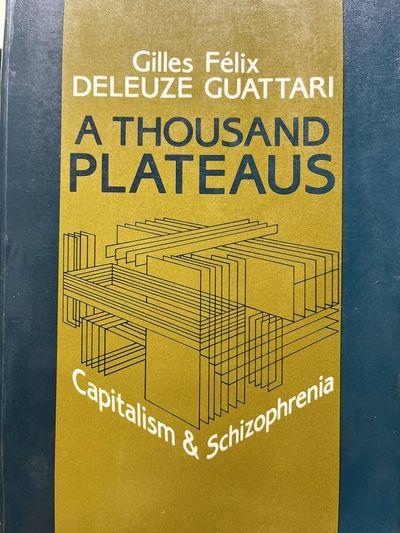
Deleuze, Gilles and Félix Guattari
1980
A Thousand Plateaus: Capitalism and Schizophrenia
trans. Brian Massumi, University of Minnesota Press, Minneapolis
An experimental work of post-structuralist philosophy covering a wide range of topics, serving as a "positive exercise" in what Deleuze and Guattari refer to as rhizomatic thought. It consists of fifteen sections called "plateaus" rather than linear chapters, each plateau connects various ideas and can be read in any order. Specific interesting terms for me are: Deterritorialization: The process of breaking free from established social, and other boundaries and controls. Body without Organs: A state of pure potential and intensity that strips away institutional organization and imposed identities. Rhizome and its rupture: A rhizome can be broken, shattered, or cut at any point, but it will always start up again along its old lines or forge new ones. Deleuze and Guattari contrast this with the destruction of a hierarchical tree, which collapses if its trunk or roots are severed. A rhizome adapts and regenerates because it lacks a vulnerable center.
Drucker, Johanna
1995
‘The Artist’s Book as Idea and Form’
in The Century of Artists’ Books, Granary Books, New York
Drucker defines an artist’s book as a work created originally as a piece of art that integrates its formal physical production means with its thematic or aesthetic intent. It distinguishes true artists' books from traditional livre d'artiste (artist's books in the French luxury tradition), which are often publisher-driven, standardized reproductions or illustrations accompanying a text rather than structural critiques of the book form itself. The physical format of a book cannot be easily pinned down to just a codex, pages, or a spine; it challenges conventional boundaries by incorporating scrolls, objects, or conceptual spaces. She introduces an interdisciplinary nature of artists' books, which sits at the crossroads of multiple disciplines, functioning simultaneously as sculptures, conceptual platforms, and sequence-based narratives.
Dyer, James and Nick Deakin
2022
Graphic Events: A Realist Account of Graphic Design
Onomatopee, Eindhoven
Graphic Events calls on graphic designers to embrace the uncertainty their designs face as they circulate in the world. It proposes that, rather than ignore the fact or to attempt to "solve" the problem, designers should play with this unpredictable process. Once an object of graphic design leaves the designer's computer, it enters an unpredictable and precarious existence in the world. Posters, packaging, and flyers may be ripped from walls, littered on streets or left to fade in shop windows. This chasm between the conception and the material life of designed objects is familiar and apparent to all, but is curiously under-theorized within the discipline.
Easterling, Keller
2021
Medium Design: Knowing How to Work on the World
Verso, London
Book as Infrastructure, Interface, Medium Design, Platform, Rhizomatic
An experimental toolbox that seeks to excavate the possibilities that reside in interconnections. It looks for ‘solutions’ that have what Easterling calls a ‘viscosity’ and a resilience which unfolds with the help of latent potentials and undisclosed disposition. Easterling is particularly poignant in her diagnosis of the cultural habits that shape how we approach problems. Easterling points out that the loop and the binary are held in custody by cultural habits of mind that draw our narratives towards ultimates. This attraction is fueled by the need for new answers to replace old solutions as we think in successive stages rather than through practice. She argues, that change is obstructed is because we get stuck in the discursive habit of formulating loops and binaries and thus obfuscate the real problem. She urges that in order to move beyond common sterile categories we must tap into the possibilities of entanglements, identifying the need for a Medium Design: ‘a matrix of undeclared activities and latent potentials’ (p.8). She seeks to provide practical examples for how to work on the world rather than simply saying that we need to work on the world. She offers hands-on suggestions for how to activate the rhizomatic power innate in our assemblages and galvanize our systems by entangling, multiplying, and inverting in order to do something as designers or architects.
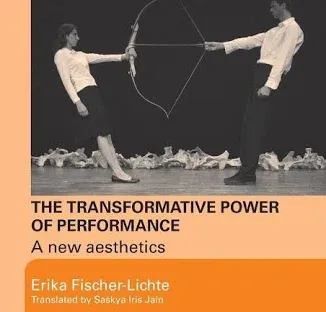
Fischer-Lichte, Erika
2008
The Transformative Power of Performance: A New Aesthetics
trans. Saskya Iris Jain, Routledge, London
Book as Event, Embodiment, Eventness, Liveness, Mise-en-scène, Performative Turn, Performativity, Transformation, Transformative Aesthetics
Through the physical presence of bodies, unpredictable interactions, and the changing relationship between performers and audience, performance can create a transformative experience that changes both the participants and the social situation in which the performance takes place. Performance has the capacity to change the people involved—both performers and spectators—rather than simply communicating a predetermined message or representing something. My selection of her key terms and concepts: One of Fischer-Lichte’s central concepts is Autopoietic feedback loop: Performers affect spectators, spectators affect performers, and these reactions continuously influence what happens next. The performance therefore produces itself through this feedback loop. Emergence: The performance develops through processes that cannot be completely predicted or controlled beforehand. What happens emerges from interactions between bodies, space, objects, sounds, and people. Liminality: Performance can place participants in an unusual or transitional state in which familiar distinctions and expectations become unstable, opening possibilities for change and transformation. What we can learn is that performance is a dynamic event created through the continuous feedback between performers and spectators, so its meaning cannot be completely determined in advance by a script, director, or performer.
Freire, Paulo
2005
Pedagogy of the Oppressed
30th anniversary edition, trans. Myra Bergman Ramos, Continuum, New York (first published 1970)
Freire critiques traditional education, which he calls the “banking model” of education, where teachers are treated as authorities who deposit knowledge into passive students. Instead, he proposes a problem-posing and dialogical form of education in which teachers and students learn from one another and critically examine the social conditions that shape their lives. For Freire, education is never completely neutral: it can either reproduce existing structures of oppression or help people recognize and transform them. Through critical consciousness, dialogue, praxis, and collective action, oppressed people can become active subjects in their own history rather than objects of someone else’s decisions. Genuine education requires dialogue between teachers and students. Knowledge is developed through communication, questioning, listening, and collective reflection rather than one-way instruction. Interesting term is "naming the world" , where language is connected to action. When people name and critically interpret their world, they can begin to understand their situation and participate in transforming it. What we can learn from the text is that education is a form of practice: through critical reflection, dialogue, and collective action, people can move from being objects of oppressive structures toward becoming active subjects in shaping their own world.
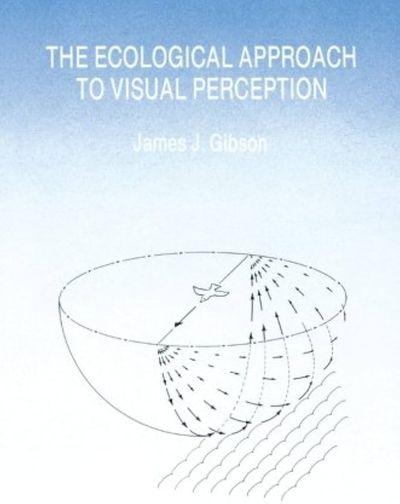
Gibson, James J.
1979
A central idea is that the environment offers different possibilities for action, which Gibson calls affordances. Perception is therefore closely connected to the organism’s practical relationship with its surroundings: we do not simply see what things are, but also perceive what they allow us to do. Gibson’s ecological approach consequently shifts attention away from perception as an internal mental representation and toward the relationship between organism, environment, and action. The environment is not simply a collection of physical objects. It is the surrounding world as it exists in relation to an organism, including surfaces, objects, other organisms, and possibilities for action. Perception and action are closely connected. What an organism perceives is related to how it can move and act within its environment.
Gingrich-Philbrook, Craig and Jake Simmons (eds.)
2023
Research Methods in Performance Studies offers a unique approach for readers to engage with performance research and methods in practice. It examines ways of making performance, researching performance cultures, researching performers who themselves are engaged in research, and conducting research in the context of enduring and emergent themes of performance studies inquiry. This book features the work of eighteen scholar-artists currently working in performance studies who demonstrate—through applied projects—various methods for conducting performance research. The result is a wide array of novel scholarship including activist performance, slam poetry, video performance, stand-up comedy, adaptation for the Broadway stage, naturecultural performance, intersectional performance, performances of cultural and material preservation, and many others.
Goffman, Erving
1959
The Presentation of Self in Everyday Life
University of Edinburgh Social Sciences Research Centre; Anchor Books, New York
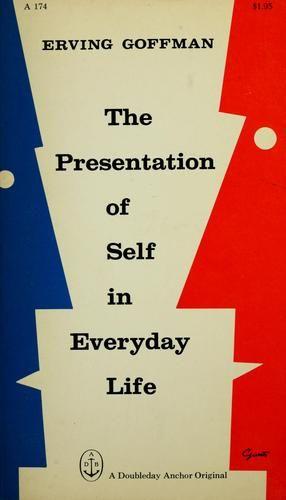
A notable contribution to our understanding of ourselves. This book explores the realm of human behavior in social situations and the way that we appear to others. Dr. Goffman uses the metaphor of theatrical performance as a framework. Each person in everyday social intercourse presents himself and his activity to others, attempts to guide and control the impressions they form of him, and employs certain techniques in order to sustain his performance, just as an actor presents a character to an audience. The discussions of these social techniques offered here are based upon detailed research and observation of social customs in many regions.
Haraway, Donna J.
2016
Haraway argues that we need to rethink how humans understand their relationship with the more-than-human world in the context of ecological crisis. Rather than imagining humans as separate from or in control of nature, she emphasizes entanglement, interdependence, and multispecies relationships. Her concept of the Chthulucene challenges the idea that the Anthropocene should be understood simply as an age in which “humans” are the central force shaping the planet. Instead, Haraway asks us to “stay with the trouble”: to remain engaged with ecological damage and uncertainty while developing new forms of collaboration, care, and coexistence with other species. The book ultimately proposes that survival depends not on finding a single technological or political solution, but on making new kinds of relationships and kinship across species. Making kin: Creating forms of relationship, responsibility, and solidarity beyond biological or human family. Humans need to recognize their dependence on many other species. Sympoiesis: Literally “making-with.” Haraway uses it to describe systems and organisms that are produced through collaboration and interdependence, rather than existing as completely autonomous individuals. Haraway argues that humans must abandon the idea of being separate from or masters of nature and instead recognize that we exist within complex multispecies relationships that continually shape one another.
Havel, Václav
1991
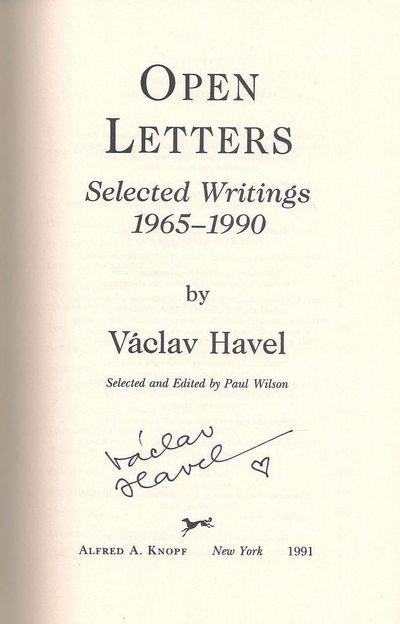
Spanning twenty-five years, this historic collection of writings shows Vaclav Havel's evolution from a modestly known playwright who had the courage to advise and criticize Czechoslovakia's leaders to a newly elected president whose first address to his fellow citizens begins, "I assume you did not propose me for this office so that I, too, would lie to you." Some of the pieces in Open letters, such as "Dear Dr. Husak" and the essay "The Power of the Powerless," are by now almost legendary for their influence on a generation of Eastern European dissidents; others, such as some of Havel's prison correspondence and his private letter to Alexander Dubcek, appear in English for the first time. All of them bear the unmistakable imprint of Havel's intellectual rigor, moral conviction, and unassuming eloquence, while standing as important additions to the world's literature of conscience.
Kaprow, Allan
1966
Assemblage, Environments and Happenings
Harry N. Abrams, New York
Action, Action Art, Assemblage, Book as Environment, Cards, Design Happening, Fluxus, Gesture, Happening, Playfulness, Score, Together, Unrepeatability
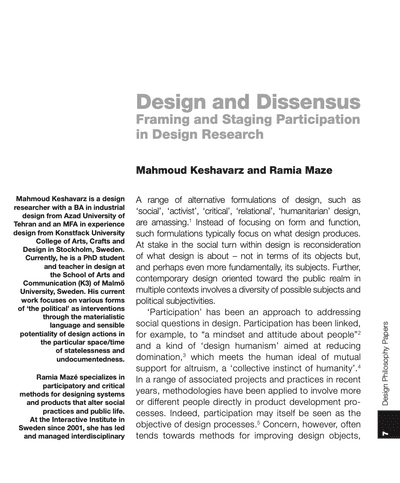
Keshavarz, Mahmoud and Ramia Mazé
2013
‘Design and Dissensus: Framing and Staging Participation in Design Research’
Design Philosophy Papers 11, no. 1, pp. 7–29
Consensus, Design Happening, Dissensus, Dissent, Friction, Inclusivity, Invitation, Others, Participatory Design, Polyvocal , Situation, Together
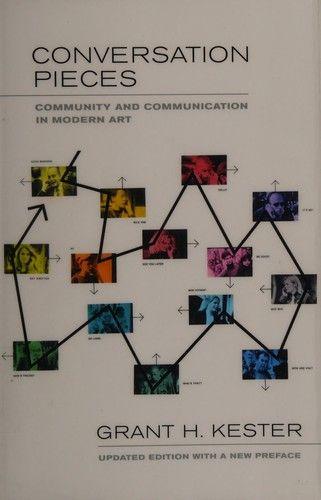
Kester, Grant H.
2004
Conversation Pieces: Community and Communication in Modern Art
University of California Press, Berkeley
Collectivity, Conversation Piece, Hosting, Participation, Relational Art
Grant Kester discusses the disparate network of artists & collectives united by a desire to create new forms of understanding through creative dialogue that crosses boundaries of race, religion, & culture.
Klimpel, Oliver
2014
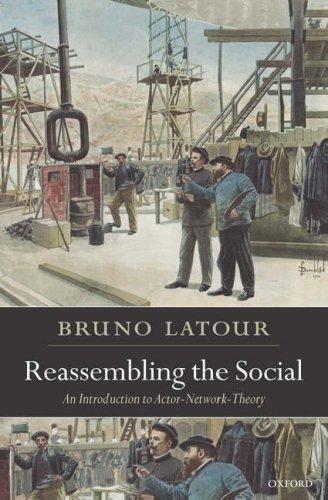
Latour, Bruno
2005
Reassembling the Social: An Introduction to Actor-Network-Theory
Oxford University Press, Oxford
Actant, Actor, Actor-Network Theory, Agency, Constituents, Non-human, Non-Human Agency, Together, Voice
Reassembling the Social is a fundamental challenge from one of the world's leading social theorists to how we understand society and the 'social'. Bruno Latour's contention is that the word 'social' as used by Social Scientists has become laden with assumptions to the point where it has become a misnomer. When the adjective is applied to a phenomenon, it is used to indicate a stabilized state of affairs, a bundle of ties that in due course may be used to account for another phenomenon. Latour also finds the word used as if it described a type of material, in a comparable way to an adjective such as 'wooden' or 'steely'. Rather than simply indicating what is already assembled together, it is now used in a way that makes assumptions about the nature of what is assembled. It has become a word that designates two distinct things: a process of assembling: and a type of material, distinct from others.^ Latour shows why 'the social' cannot be thought of as a kind of material or domain, and disputes attempts to provide a 'social explanation' of other states of affairs. While these attempts have been productive (and probably necessary) in the past, the very success of the social sciences mean that they are largely no longer so. At the present stage it is no longer possible to inspect the precise constituents entering the social domain. Latour returns to the original meaning of 'the social' to redefine the notion and allow it to trace connections again. It will then be possible to resume the traditional goal of the social sciences, but using more refined tools. Drawing on his extensive work examining the 'assemblages' of nature, Latour finds it necessary to scrutinize thoroughly the exact content of what is assembled under the umbrella of Society.^ This approach, a 'sociology of associations' has become known as Actor-Network-Theory, and this book is an essential introduction both for those seeking to understand Actor-Network-Theory, or the ideas of one of its most influential proponents.
Lehmann, Hans-Thies
2006
Postdramatic Theatre
trans. Karen Jürs-Munby, Routledge, London
Book as Process, Postdramatic Theatre, Processuality, Script, Unfinished
Hans-Thies Lehmann's groundbreaking study of the new theatre forms that have developed since the late 1960s has become a key reference point in international discussions of contemporary theatre. Postdramatic Theatre refers to theatre after drama. Despite their diversity, the new forms and aesthetics that have evolved have one essential quality in common: they no longer focus on the dramatic text." "Lehmann offers a historical survey combined with a unique theoretical approach, illustrated by a wealth of practical examples, to guide the reader through this new theatre landscape. He considers these developments in relation to dramatic theory and theatre history, and as an inventive response to the emergence of new technologies and a historical shift from a text-based culture to a new media age of image and sound. Engaging with theoreticians of drama and theatre from Aristotle, Hegel, Szondi and Brecht to Barthes, Lyotard and Schechner, the book analyses the work of recent experimental theatre practitioners such as Robert Wilson, Tadeusz Kantor, Heiner Muller, The Wooster Group, Needcompany and Societas Raffaello Sanzio." "This excellent translation is newly adapted for the Anglophone reader, including an introduction by Karen Jurs-Munby which provides useful theoretical and artistic contexts for the book.
Longley, Alys, Nancy Duxbury and W.F. Garrett-Petts (eds.)
2020
Artistic Approaches to Cultural Mapping: Activating Imaginaries and Means of Knowing
Routledge, London
Massumi, Brian
1995
‘The Autonomy of Affect’
Cultural Critique, no. 31 (University of Minnesota Press), pp. 83–109
McKenzie, Jon
2001
'Performance' has become one of the key terms for the new century. But what do we mean by 'performance'? In today's world it can refer to experimental art; productivity in the workplace; and the functionality of technological systems. Do these disparate fields bear any relation to each other?In Perform or Else Jon McKenzie asserts that there is a relationship between cultural, organisational and technological performance. In this theoretical tour de force McKenzie demonstrates that all three operate together to create powerful and contradictory pressures to 'perform...or else'. This is an urgent and important intervention in contemporary critical thinking. It will profoundly shape our understanding of twenty-first century structures of power and knowledge.

McLuhan, Marshall
1962
The Gutenberg Galaxy: The Making of Typographic Man
University of Toronto Press, Toronto
Flatness, Gutenberg Galaxy, Obsolescence, Surface , Typography
The Gutenberg Galaxy catapulted Marshall McLuhan to fame as a media theorist and, in time, a new media prognosticator. Fifty years after its initial publication, this landmark text is more significant than ever before. Readers will be amazed by McLuhan’s prescience, unmatched by anyone since, predicting as he did the dramatic technological innovations that have fundamentally changed how we communicate. The Gutenberg Galaxy foresaw the networked, compressed ‘global village’ that would emerge in the late-twentieth and twenty-first centuries — despite having been written when black-and-white television was ubiquitous. This new edition of The Gutenberg Galaxy celebrates both the centennial of McLuhan’s birth and the fifty-year anniversary of the book’s publication. A new interior design updates The Gutenberg Galaxy for twenty-first-century readers, while honouring the innovative, avant-garde spirit of the original. This edition also includes new introductory essays that illuminate McLuhan’s lasting effect on a variety of scholarly fields and popular culture. A must-read for those who inhabit today’s global village, The Gutenberg Galaxy is an indispensable road map for our evolving communication landscape.
Miessen, Markus
2010
The Nightmare of Participation: Crossbench Praxis as a Mode of Criticality
Sternberg Press, Berlin
Facilitation, Friction, Hosting, Instrumentalization, Nightmare of Participation
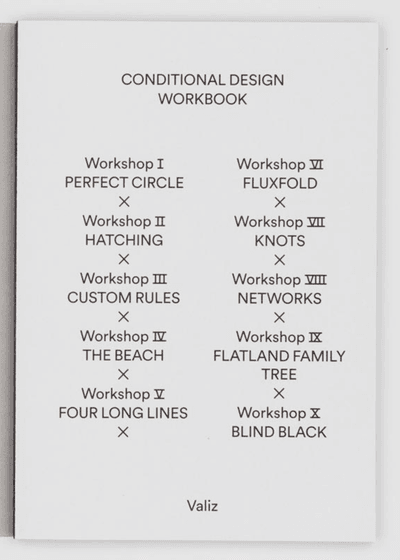
Moniker (Luna Maurer, Edo Paulus, Jonathan Puckey and Roel Wouters)
2008
"The process is the product. The most important aspects of a process are time, relationship and change. The process produces formations rather than forms. We search for unexpected but correlative, emergent patterns. Even though a process has the appearance of objectivity, we realize the fact that it stems from subjective intentions. ... Logic is our tool. Logic is our method for accentuating the ungraspable. A clear and logical setting emphasizes that which does not seem to fit within it. We use logic to design the conditions through which the process can take place. Design conditions using intelligible rules. Avoid arbitrary randomness. Difference should have a reason. Use rules as constraints. Constraints sharpen the perspective on the process and stimulate play within the limitations." – Moniker, 2008
Norman, Don
2013
The Design of Everyday Things
revised and expanded edition, Basic Books, New York
Norman writes about how human-centered design makes products intuitive, usable, and enjoyable. Much of the book's concepts such as discovering user's needs, affordance, and design thinking are already known to me, these concepts coined by Norman have become so popular that they have permeated much of the design essay space.
Panting, Lisa
2017
‘Between Body and Object’
in Bridget Crone (ed.), The Sensible Stage: Staging and the Moving Image, Intellect, Bristol
"Between the body and object the voice appears. Bridging the space between objects – simultaneously props, maybe even sculptures. Perhaps it is their status in tension with the performance that enlivens them – part object, prop or sculpture dependent on the forms of address moving through them – an action, a quotation and a recitation. Yael Davids’ Learning to Imitate (2010) and Learning to Imitate in Absentia (2011) propose a manifold relationship to time and space. The before and after of the space – that is the temporality that moves with and through these mise en scènes – enables the works to mediate both installation and performance. Coalescing in the space between art and theatre these performances operate through a series of slippages of signs and systems." – Lisa Panting, in The Sensible Stage, (p.117).
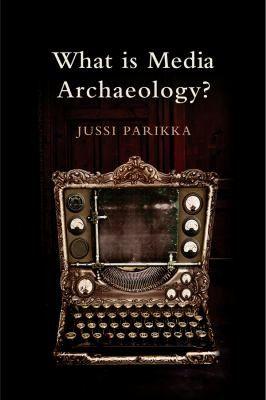
Parikka, Jussi
2012
Media archaeology examines forgotten, obsolete, alternative, and recurring media technologies and practices. Parikka draws on archaeology, media theory, cultural history, and technology studies to show that contemporary media are shaped by earlier technologies, ideas, and cultural practices that have not simply disappeared. Media archaeology therefore makes it possible to uncover alternative histories of media and to understand how the past continues to operate within contemporary technological culture. Media history does not move smoothly from old → new → better. Earlier technologies, ideas, and practices can return, persist, or influence supposedly new media.
Pavis, Patrice
2020
The Routledge Dictionary of Performance and Contemporary Theatre
Routledge, London
Act, Actor, Dramaturgy, MA, Mise-en-scène, Script, Stage, Theatricality
"From the Anglo-American point of view, theatre seems to have become a cultural performance, a performative activity: even if people still create works of art in it, entire swathes of social life have become the object of research that is more anthropological than aesthetic in nature. And indeed, if we view performativity as something that lies behind a certain way of doing something, of finding a place in social space, of ‘applying’ theatre to educational or political ends (as ‘applied theatre’ does), we then see that the ‘theatrical’ landscape has indeed changed a great deal since the 1990s." – Pavis, Patrice. The Routledge Dictionary of Performance and Contemporary Theatre (p. xi).
Puig de la Bellacasa, María
2017
Matters of Care: Speculative Ethics in More Than Human Worlds
University of Minnesota Press, Minneapolis
Book as Care, Care, Feminist Methodologies, Kinship, Matters of Care, More-Than-Human, Speculative Ethics
la Bellacasa develops an understanding of care as an ethical, political, and material practice that extends beyond human relationships. She challenges the idea that care is simply a positive feeling or a moral virtue, arguing instead that care involves work, responsibility, attachment, dependency, and sometimes conflict. By focusing on more-than-human worlds, she asks us to consider how humans are entangled with animals, plants, technologies, environments, objects, and other forms of life. Care therefore becomes a way of recognizing interdependence and vulnerability while also asking who or what is cared for, who performs care, and under what conditions. Her approach emphasizes that care is not about achieving a perfect or harmonious world, but about staying involved with the messy realities of living together and maintaining the worlds we depend on. Care is an ongoing and sometimes difficult practice of responding to interdependence, vulnerability, and the needs of the worlds we share.
Rancière, Jacques
2009
The Emancipated Spectator
trans. Gregory Elliott, Verso, London
Activate, Consensus, Dissensus, Emancipated Spectator, Engagement, Passive, Playfulness, Spect-Actor, Spectator
In this title, the foremost philosopher of art argues for a new politics of seeing. The role of the viewer in art and film theory revolves around a theatrical concept of the spectacle. The masses subjected to the society of spectacle have traditionally been seen as aesthetically and politically passive - in response, both artists and thinkers have sought to transform the spectator into an active agent and the spectacle into a performance. In this follow-up to the acclaimed "The Future of the Image", Ranciere takes a radically different approach to this attempted emancipation. Beginning by asking exactly what we mean by political art or the politics of art, he goes on to look at what the tradition of critical art, and the desire to insert art into life, has achieved. Has the militant critique of the consumption of images and commodities become, instead, a melancholic affirmation of their omnipotence?
Rogoff, Irit
2019
‘Becoming Research’
lecture, Sonic Acts Festival: HEREAFTER, Amsterdam, 22 February 2019
Artistic Research, Becoming, Becoming Research, Design epistemology
Rogoff examines what she calls the “Research Turn” in contemporary art and curatorial practice. She argues that research is increasingly moving away from being a preliminary activity that simply provides background knowledge for an artwork or exhibition and is becoming a mode of practice in itself. Rather than beginning with established or “inherited” knowledge and using it to produce something, Rogoff proposes “working from conditions”: starting from the social, political, economic, and institutional circumstances in which we currently live and allowing these conditions to shape the research process. Rogoff also emphasizes that contemporary artistic research can operate through invention, speculation, experimentation, and embodied forms of knowing, rather than being limited to conventional academic standards of proof and verification. Research therefore becomes something that is produced through practice
Ruller, Tereza
2014
Action to Surface
graduation thesis, Royal Academy of Art (KABK), The Hague
https://www.therodina.com/performativedesignCommunication Design, Design skills, Liminality, Performativity, Playfulness, Surface , Unrepeatability
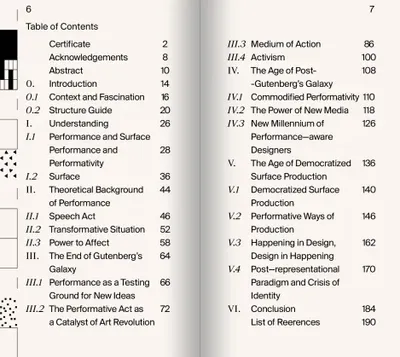
Action to Surface (2015) is my BA thesis coining the term performative design. My main argumentation is on how performativity, the body, and action shape the production of the contemporary graphic surface. And how communication designers can reclaim their agency in designing actions, situations, and surfaces by understanding the performative methods. It claims that surface production could be an action, happening, or chance-driven act. In addition to this, I try to step out of separated media constrains and tend to establish a new field of potential through identifying performative components in graphic design processes and results.Conducted at KABK in Den Haag.
Schechner, Richard
2013
Schuler, Douglas and Aki Namioka (eds.)
1993
Participatory Design: Principles and Practices
Routledge, London
Democracy, Facilitation, Inclusivity, Participatory Design, User
Solte, Franziska
2020
‘Guy de Cointet: The Theatricality of the Code’
Signata: Annales des sémiotiques, no. 11
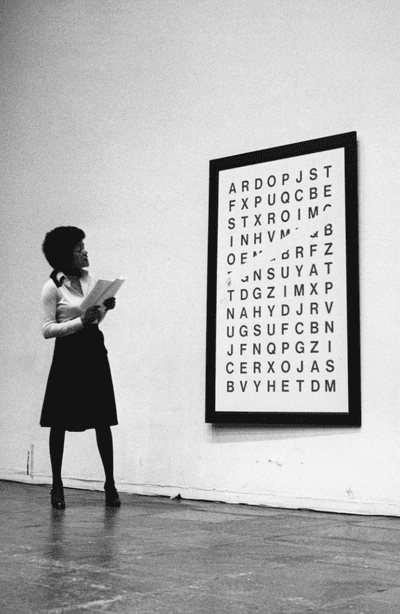
Cointet's play performance reveals two key structural features that exemplify his stagings: on the one hand, his engagement with codification, which serves as the starting point of the performance, whether in the form of a cryptic artist’s book, a series of graphic works, a painting, or in later years, an abstract ensemble of objects; and on the other hand, theatricality as the modus operandi of his performances, a staged scene devoted to the explanation or decoding of the work. It is this relationship between an enigma and its solution... The artist Guy de Cointet developed 23 performances during the period between 1972 and his premature death in 1983 in Los Angeles. After studying at the National Art School in Nancy and working in the field of graphic design in Paris for suchjournals as Vogue, he headed to New York City in 1965. Moving in the circles of Warhol’s Factory, he then moved to LA.
Sontag, Susan
2009
Against Interpretation and Other Essays
Penguin Classics, London (first published 1966); includes ‘Happenings: An Art of Radical Juxtaposition’
Action, Action Art, Book as Event, Event, Happening, Performance
'Against Interpretation' was Susan Sontag's first collection of essays and is a modern classic. Originally published in 1966, it has never gone out of print and has influenced generations of readers all over the world. It includes some of Sontag's best-known works, among them "On Style", "Notes on 'Camp", and the titular essay "Against Interpretation", where Sontag argues that modern cultural conditions have given way to a new critical approach to aesthetics.
Turner, Victor
1982
From Ritual to Theatre: The Human Seriousness of Play
PAJ Publications, New York
How is social action related to aesthetics, and anthropology to theatre? What is the meaning of such concepts as "work," "play, "liminal," and "flow"? In this highly influential book, Turner elaborates on ritual and theatre, persona and individual, role-playing and performing, taking examples from American, European, and African societies for a greater understanding of culture and its symbols.